
About me and How it works
Have a question? get in touch
info@ondrejpavlovic.cz
I’m a movement enthusiast and a lifelong student of how the human body works. What fascinates me most is how interconnected everything is: the musculoskeletal system, mental well-being, and the way our internal systems function all influence each other. That’s why I approach training and therapy as a whole—looking for connections rather than isolated symptoms.
My background combines human biology, physiotherapy, and long-term coaching practice. I studied Human Anthropology & Genetics (RNDr.) and Theoretical Biology (Ph.D.) at Charles University in Prague, and later completed a Master’s degree in Applied Physiotherapy (FTVS UK).
I also spent a year working as a movement therapist in a psychiatric rehabilitation setting (Centrum duševní rehabilitace, Beroun).
I’ve been coaching individuals and groups for more than 10 years and teaching future coaches in a trainer education school for almost 7 years.
I treat every person as an individual. The plan always adapts to current needs and possibilities—whether the goal is performance, returning after an injury, managing long-term aches, or simply enjoying training and feeling better in your body.
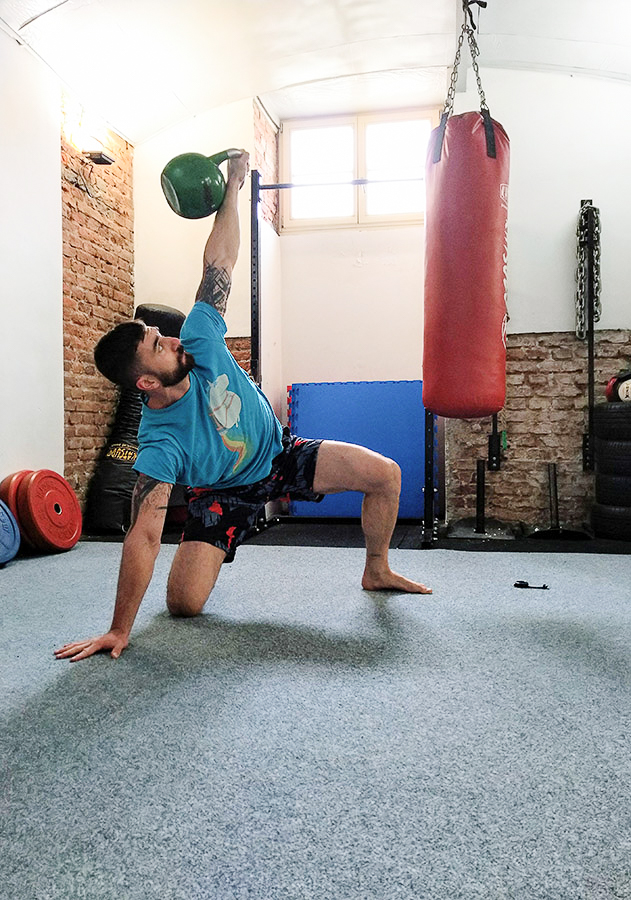
Over the years I’ve tried a wide range of sports and movement disciplines—competitive swimming, cross-country skiing, triathlon, parkour, Muay Thai, weightlifting, CrossFit, and Brazilian jiu-jitsu. I also do things like OCR races, kickboxing, and calisthenics for fun. These days I’m especially into kettlebells and bodyweight movement training.
“A jack of all trades is a master of none, but oftentimes better than a master of one.”
From assessment to consistency
How it works?
We start with a thorough intake and movement assessment. The first session is usually focused on getting the full picture: goals, training history, current lifestyle, injuries, and what’s been going on lately.
We’ll look at basic movement patterns, mobility, strength and weak links, and any functional or structural imbalances that may be limiting progress—or causing pain.
Next, we build a routine that fits goals, schedule, and current capacity. Often we’ll start by improving mobility and body control through simple drills, playful movement tasks, and basic “re-learning” patterns.
Most of the time we only need a floor, a pull-up bar, a ball or a stick—sometimes resistance bands. For strength and conditioning we’ll use free weights (kettlebells, dumbbells, a barbell, medicine balls) and bodyweight exercises.
I believe strong fundamentals work best, so there’s no pressure to chase the newest fitness trends or gimmicky equipment. That said—you might feel muscles you didn’t even know you had.
The goal isn’t to destroy anyone in the first session. Technique and quality come first: doing less, but doing it well beats doing more with poor form.